Materiality Management
To fully understand the expectations of stakeholders from all sectors, TiMOTION refers to the GRI 2021 Guidelines and the AA1000 SES Standards to conduct stakeholder identification and materiality analysis, assessing the various impacts of its operations on the economy, the environment, people, and human rights.
Procedure of Materiality Analysis
Understand the Organizational Context
Operations and Macro Market Analysis, Stakeholder Identification
Identify the Actual and Potential Impact
Establish a List of Sustainability Issues
Assess the Significance of Impact
Overall assessment of impact severity and level of concern
Prioritize the Reporting of the Most Significant Impact
Determine the material topics
Operations and Macro Market Analysis
TiMOTION’s operational activities include the customized design, manufacturing, packaging, quality inspection, and shipping of electric linear actuator products. Each stage must strictly comply with customer product certification requirements, with particular emphasis on product innovation and delivery times. As part of its global strategy, TiMOTION considers various factors, including raw materials, production process management, and customer satisfaction surveys.
Stakeholder Identification
Based on the organizational overview described above and the actual business partners involved in TiMOTION’s operations, and in reference to the five principles of the AA1000 SES: 2015 Stakeholder Engagement Standard (degree of dependence, responsibility, level of concern, influence, and diversity of perspectives), the following key stakeholders have been identified: shareholders/investors, banks, employees, customers, suppliers, local communities, and government agencies.
Establish a List of Sustainability Issues
TiMOTION, considering market trends, regulatory requirements, and standards such as the GRI Guidelines, SASB Industry Standards, and TCFD Guidelines, selected a total of 18 sustainability issues to conduct assessments of positive and negative sustainability impacts and surveys on stakeholder engagement.
- Economic and Corporate Governance Aspects (6 items): Ethical Business Practices, Regulatory Compliance, Information Security, Customer Management, Ability to Expand into New Markets, Risk Management
- Product Aspects (2 items): R&D and Innovation Capabilities, Product Quality and Product Responsibility
- Supplier Management (1 item): Supplier Management
- Environmental Aspects (3 items): Energy Management, Energy Conservation and Carbon Reduction, Pollution Prevention
- Social Aspect (6 items): Human Rights Management, Human Capital Management, Labor-Management Communication, Diversity and Inclusion, Occupational Safety and Health, Social Engagement
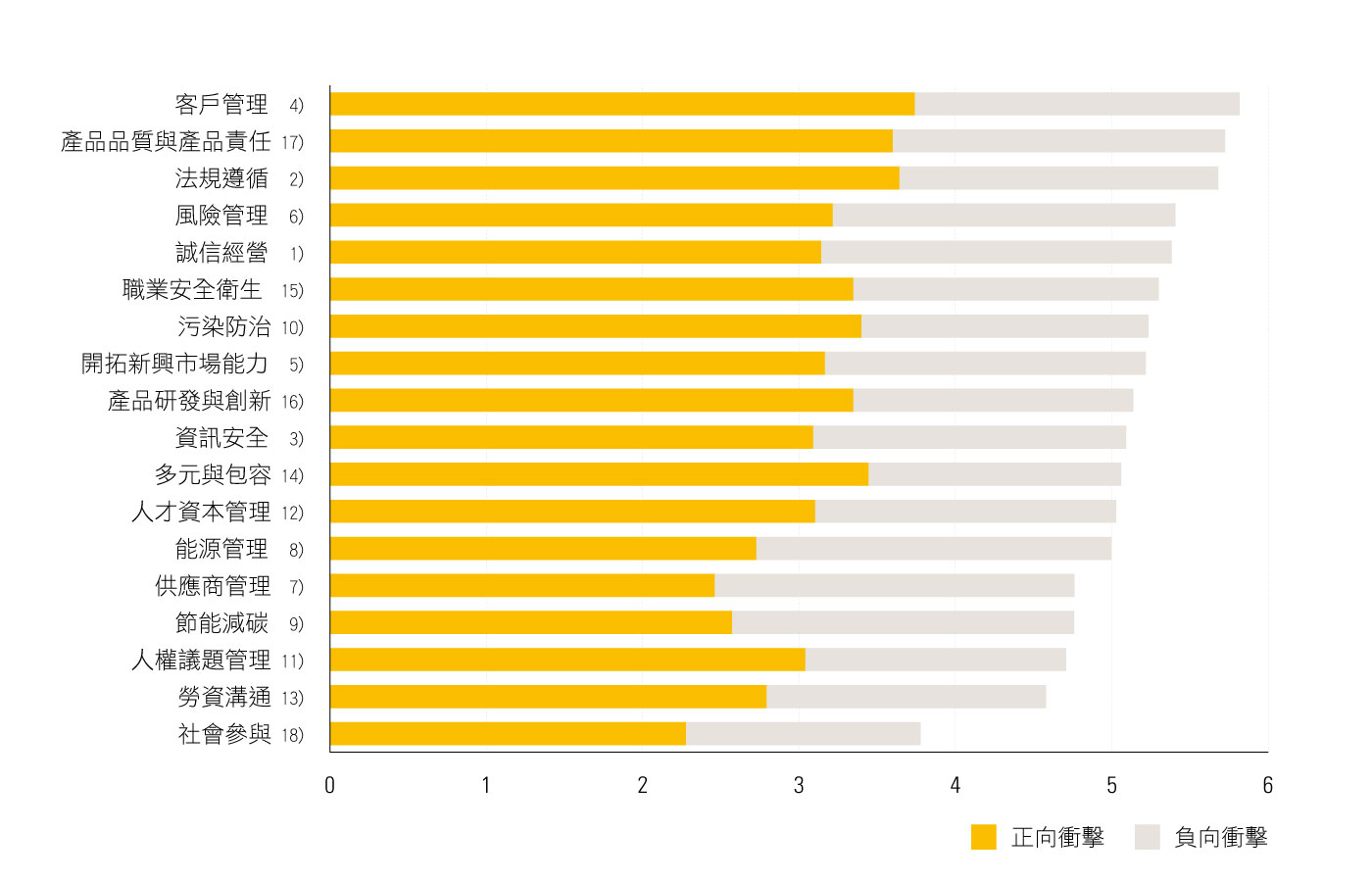
The Sustainability Task Force invited 30 supervisors above the section level to assess the severity and likelihood of both positive and negative impacts on each issue. The results are shown in the figure below. Issues with high positive impacts, in order of highest average scores, include Customer Management, Product Quality and Product Responsibility, and Regulatory Compliance. Issues with high negative impacts, in order, are Supplier Management, Energy Management, and Ethical Business Practices.
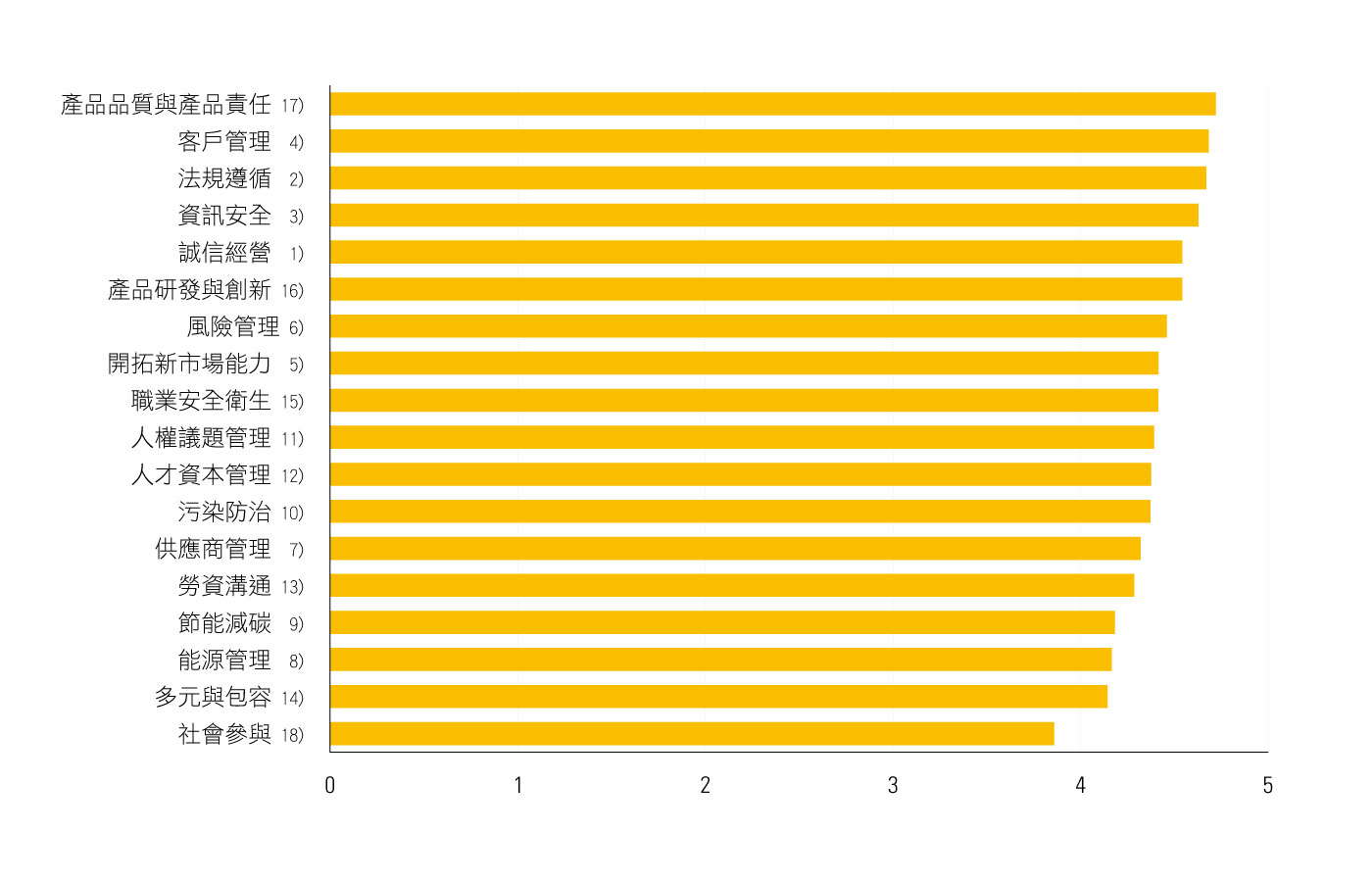
TiMOTION invited stakeholders from various categories to participate in a priority survey and obtained a total of 123 valid responses. The ranking of priority results is shown in the figure above:
Assess the Significance of Impact
TiMOTION conducted a comprehensive assessment of the positive and negative impacts of each issue, their likelihood of occurrence, and stakeholder concern levels. Priority was given to issues with negative impacts above the average and stakeholder concern levels above the average, which were considered for designation as material topics for management. Ultimately, following a senior management meeting, eight material topics were identified.
List of Material Topics in 2025
| ESG Focus | Key Themes | The Importance of TiMOTION | Alignment with the SDGs | Compliance with GRI Standards and SASB Indicators | Value Chain Impact Assessment | 2025 Targets | 2025 Results | Relevant Sections | |||
|---|---|---|---|---|---|---|---|---|---|---|---|
| Upstream | TiMOTION | Downstream | |||||||||
| G | Supplier Management | Effective supplier management ensures a stable supply of raw materials and reduces operational risks | SDG 9 · SDG 12 |
| V | V | — | 100% of new suppliers sign the Supplier Code of Conduct | Both the Taichung and Dongguan plants have achieved | Supplier Management | |
| G | R&D and Innovation | R&D and innovation capabilities help maintain TiMOTION’s competitiveness and sustain its growth momentum | SDG 9 · SDG 12 | TC-HW-230a.1 | V | V | V |
|
| R&D and Innovation | |
| G | Product Quality and Responsibility | Product quality and responsibility directly impact customer trust and TiMOTION’s operational performance | SDG 9 · SDG 12 |
| V | V | V |
|
| Product Quality and Responsibility | |
| G | Customer Management | Comprehensive customer management helps TiMOTION stay abreast of changes in customer needs, improve service quality, maintain customer trust, and strengthen long-term orders and brand competitiveness | SDG 9 · SDG 12 | GRI 416: Customer Health and Safety 2016 | V | V | V | Conduct a customer satisfaction survey, revise the questionnaire items and scoring weights for the four major product lines, and set the base year | Customer Satisfaction by Product Line
| Customer Relationship Management | |
| E | Environmental Management in the Production Process | Environmental management in the manufacturing process helps ensure compliance with regulations, reduce pollution and resource waste, and demonstrate corporate responsibility | SDG 9 · SDG 12 · SDG 13 |
| V | V | V |
|
| Environmental Management in the Production Process | |
| E | Energy Conservation and Carbon Reduction | Energy conservation and carbon reduction can improve TiMOTION’s efficiency and performance, and align with global climate action | SDG 7 · SDG 12 · SDG 13 |
| V | V | — | 3.5% share of renewable photovoltaic energy | Proportion of renewable photovoltaic energy used at the Dongguan plant: 3.69% | Energy Conservation and Carbon Reduction | |
| S | Human Capital Management | Human capital management is the cornerstone of TiMOTION’s stable development and ensures that TiMOTION remains competitive | SDG 4 · SDG 5 · SDG 8 |
| — | V | — |
| The following are sites in Taiwan:
| Human Capital Management | |
| S | Occupational Safety and Health | Effective occupational safety and health management ensures the safety and health of employees, maintains stable production, and enhances TiMOTION’s image as a socially responsible enterprise | SDG 3 · SDG 8 | GRI 403: Occupational Safety and Health 2018 | V | V | — |
|
| Occupational Safety and Health | |